
What Is Knee Replacement? Indications, Procedure & Recovery

Knee replacement (artificial knee replacement surgery) is an intensive surgical solution that removes the surface of severely damaged articular cartilage and subchondral bone, then reconstructs it with highly biocompatible artificial materials including medical alloys and polyethylene cushions. This is the optimal method to help patients with severe knee osteoarthritis relieve persistent pain, correct axial deformities and restore independent mobility..
1. What is knee replacement?
Knee Arthroplasty is a surgery to reshape the damaged knee joint with specialized artificial parts. In this surgery, the orthopedic surgeon does not remove the entire knee joint as many people mistakenly believe, but only dissects the worn surface of the articular cartilage, reshapes the bone surfaces and places artificial components in the corresponding positions to help the knee joint move smoothly..
This surgery is commonly and closely performed in the specialty of Orthopedics. The main goal is to completely reduce pain, straighten the lower limb anatomy and help the patient return to daily activities smoothly..
Anatomical structure of the knee joint
The knee joint is one of the largest and most complex load-bearing joints in the body, made up of three main bone components: the lower end of the femur, the upper end of the tibia and the patella. The surface of the bone ends is covered by a layer of articular cartilage 3 - 4mm thick with a smooth surface, along with two meniscus discs (inner and outer) that act as shock absorbers to evenly distribute mechanical pressure..
The ligament system (anterior cruciate ligament, posterior cruciate ligament, internal and external ligament) combined with the front quadriceps muscle group keeps the knee joint moving firmly. When the articular cartilage layer is degenerated, cracked or completely eroded, the ends of the bones rub directly against each other, causing pain, inflammation, bone spur formation and severe limitation of movement..
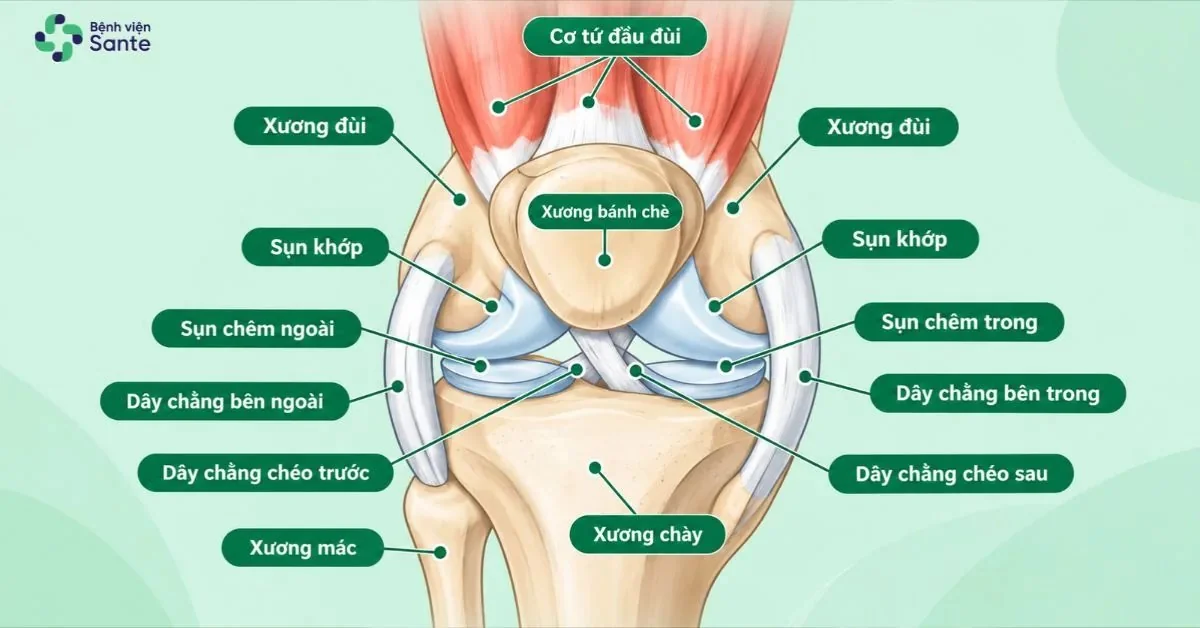
What parts does the artificial knee joint consist of?
Modern artificial knee joints are made from highly biocompatible medical alloys (such as Cobalt – Chromium or Titanium) combined with ultra-high molecular density medical plastic (UHMWPE). A standard artificial knee joint set consists of 3 main components:
- Femoral Component: Curved metal fits tightly around the lower end of the femur, recreating the sliding surface of the femoral condyle.
- Tibial Component: It consists of a metal base securely anchored onto the upper surface of the tibia and a medical-grade polyethylene insert placed above, which serves as a replacement for articular cartilage to facilitate smooth and effortless flexion and extension.
- Patellar Component: When the posterior cartilage of the kneecap is severely worn down, specialists can resurface it using a dome-shaped medical-grade polyethylene component.
The implant type, dimensions, and biocompatible materials are meticulously customized by our specialists to align perfectly with each patient's anatomical bone structure, age, and lifestyle activity levels.
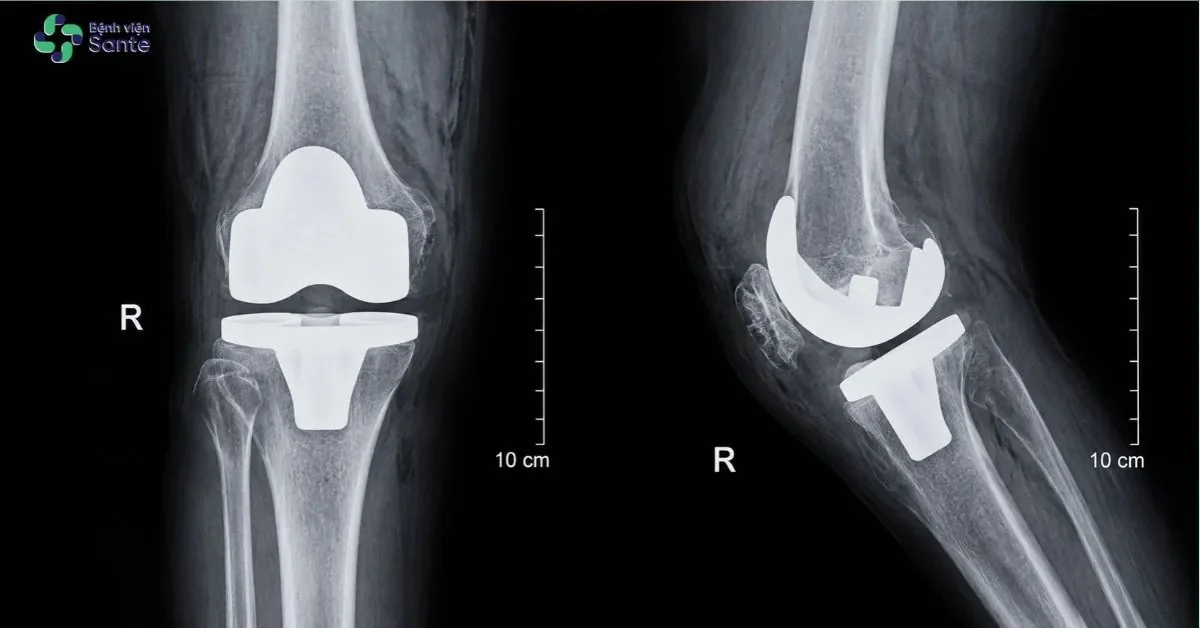
2. When Is Knee Replacement Surgery Indicated?
Knee replacement surgery is recommended when advanced joint degeneration severely impairs daily functioning, and conservative modalities—such as medical therapy, physical rehabilitation, and intra-articular injections—no longer provide meaningful pain relief.
Common Clinical Indications for Knee Replacement Surgery
- Severe knee osteoarthritis (grade III – IV according to Kellgren-Lawrence): Marked joint space narrowing or ankylosis, characterized by complete cartilage loss leading to direct bone-on-bone articulation.
- Rheumatoid Arthritis and Autoimmune Arthropathies: Chronic inflammatory cascades that progressively destroy the articular cartilage and subchondral bone across the knee joint.
- Post-Traumatic Secondary Osteoarthritis: Sequelae resulting from intra-articular fractures, tibial plateau disruptions, or multi-ligament knee injuries leading to limb mechanical malalignment.
- Avascular Necrosis of the Epiphysis (Osteonecrosis): Lack of blood supply causes collapse of the femoral condyle or tibial plateau.
- The knee joint is severely deformed: Legs that are misaligned are varus (O) or valgus (X) causing great difficulty in walking.
5 warning signs that you need to see a specialist early
- Persistent knee pain: Severe pain when walking, pain even when resting or causing insomnia at night.
- Joint stiffness and limited range of motion: Difficulty in stretching legs, unable to bend knees to stand up or sit down or climb stairs.
- Joints are deformed and swollen: The legs are clearly crooked and the knee joints are swollen and swollen over and over again.
- Rattling, crunching sounds accompanied by sharp pain: The feeling of bones rubbing dryly every time you move your knee.
- Conservative treatment for more than 6 months did not help: Anti-inflammatory drugs, platelet-rich plasma (PRP) injections or hyaluronic acid injections no longer relieve the pain.

3. Contraindications for knee replacement
To ensure absolute safety for the patient, orthopedic surgeons will carefully evaluate contraindications.:
Absolutely contraindicated
- There is a progressive infection in the knee joint or any infection in the body (sepsis, pyoderma, dental infection).
- Complete loss of function of the knee extensor mechanism (irreversible tear of the quadriceps tendon or patellar tendon).
- Severe occlusive disease of lower extremity arteries threatens leg necrosis.
- Charcot arthropathy is caused by chronic nerve damage causing profound loss of sensation.
Relative contraindications (requires preparation and delay)
- Severe obesity (BMI >= 35 - 40 kg/m²), requires a weight loss regimen before surgery to reduce pressure on the new joint.
- Poorly controlled diabetes (HbA1c > 8%), endocrine consultation is needed to stabilize blood sugar before surgery.
- Cardiovascular disease, kidney failure or coagulation disorders are not optimally controlled.
- Ulceration and fungal skin infection in the area around the knee joint scheduled for surgery.
4. Current knee replacement surgery methods
Depending on the extent of articular cartilage damage on X-ray and the condition of the ligaments, the doctor will prescribe the most appropriate surgical method.:
Total Knee Replacement (TKR)
This is the most commonly applied technique, indicated when the articular cartilage is severely damaged in 2 or more compartments. The doctor will replace the entire cartilage surface of the lower end of the femur, the upper end of the tibia and the back of the kneecap (if necessary). This method helps thoroughly correct axial deformities and provides long-term stability.
Partial Knee Replacement (PKR)
Indicated when cartilage damage is only localized in a single compartment (usually the inner compartment), while the remaining compartment and the entire anterior and posterior cruciate ligament system are still completely healthy. The doctor only replaces the damaged cavity, preserving as much natural bone and ligaments as possible, resulting in smaller incisions, less pain and faster recovery..
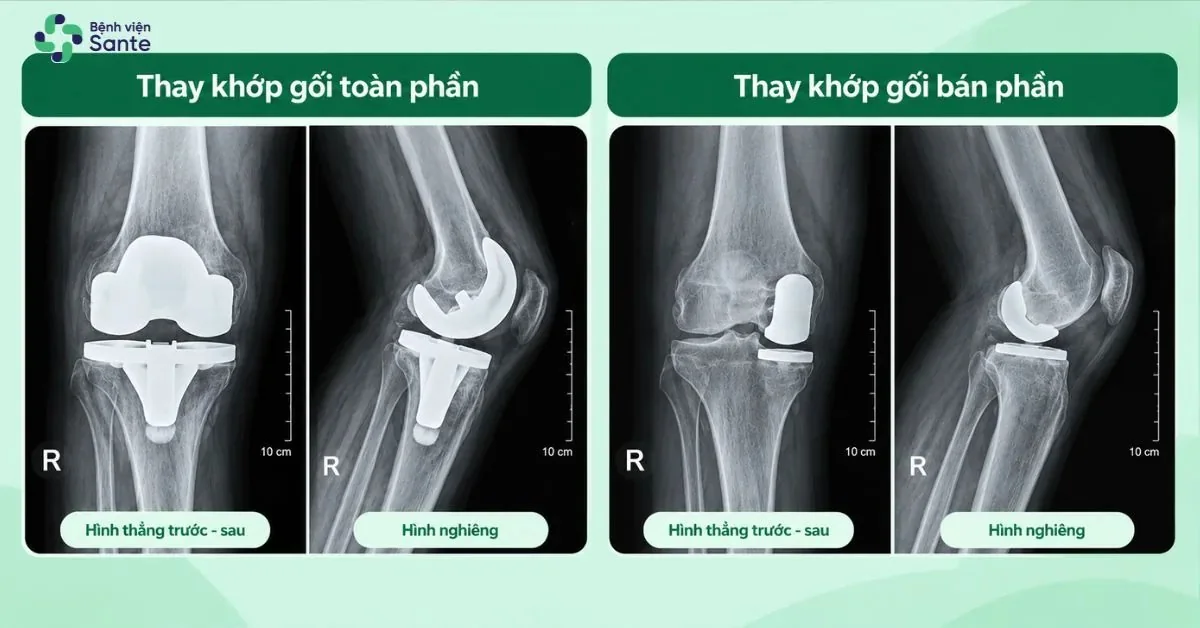
Detailed comparison table: Total knee replacement vs. Partial knee replacement
| Comparison Criteria | Total Knee Replacement (TKR) | Partial knee replacement (PKR) |
|---|---|---|
| Scope of damage | Damage to 2 - 3 joint compartments | The damage is localized in a single cavity |
| Incision & invasion | The incision is about 12 - 15 cm long | Small incision about 6 - 8 cm (less invasive) |
| Preserve the cruciate ligament | Usually the anterior cruciate ligament is removed | 100% preservation of anterior and posterior cruciate ligaments |
| Blood loss & pain level | Moderate blood loss, moderate pain | Very little blood loss, milder pain level |
| Hospital stay | About 3 – 5 days | About 1 – 2 days |
| Natural feeling of movement | Good, knee flexion range 110° – 120° | Very natural, knee flexion range > 125° |
| Lifespan of artificial joints | 15 – 25 years (joint survival rate > 90%) | 10 – 15 years (can be converted into TKR) |
5. Medical standard knee replacement surgery procedure at SANTE
At Sante Hospital, knee replacement surgery is performed according to a closed, standardized process as recommended by the American Association of Orthopedic Surgeons (AAOS) and the Ministry of Health.:
Phase 1: Comprehensive preoperative assessment
The patient has a digital X-ray system that measures the entire lower limb axis in a standing position with pressure (HKA - Hip Knee Ankle angle measurement) to accurately quantify axial deviation. Combined with an MRI of the knee joint to evaluate the menisci, ligaments and perform a set of pre-anesthesia tests to check the heart, lungs, liver function, kidneys and blood sugar..
Stage 2: Preparation in the ISO 6 positive pressure sterile operating room
Positive pressure operating room system with HEPA air filter and one-way laminar flow airflow meeting ISO Class 6 standards, strict sterility control to minimize the risk of surgical infection.
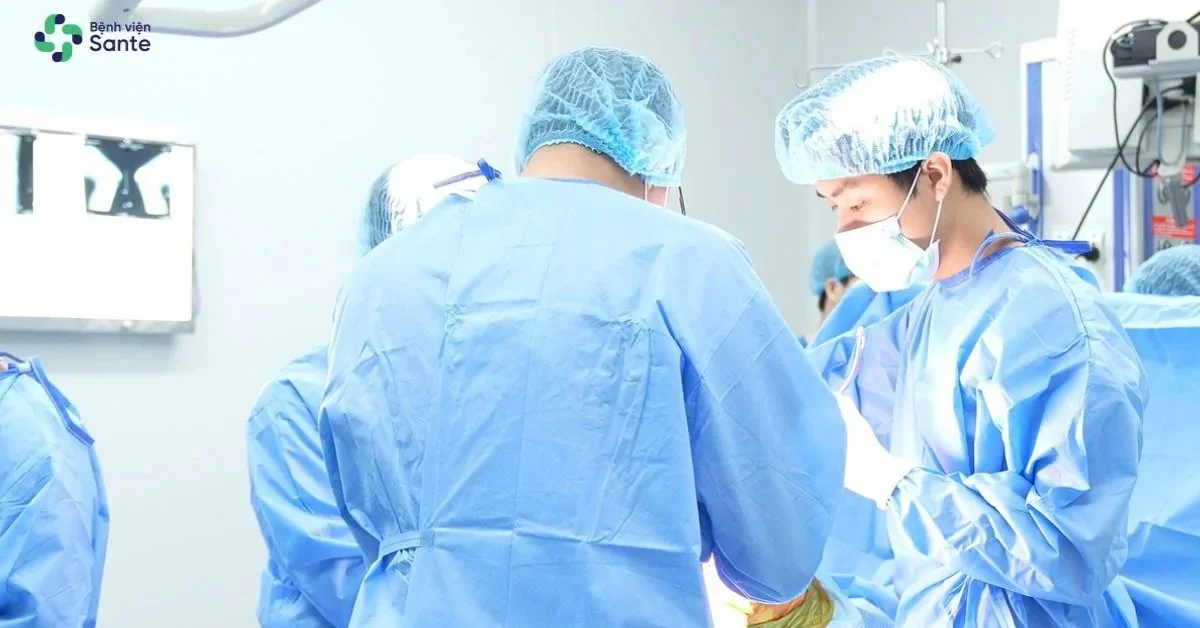
Stage 3: Perform precise surgery
The patient is given spinal anesthesia combined with modern femoral/ sciatic nerve pain relief techniques. The doctor exposes the joint surface and uses specialized positioning measures to accurately remove the damaged bone and cartilage layer. The trial joint is attached to check ligament balance and flexion and extension amplitude, before officially fixing the component with specialized medical biological cement..
Stage 4: Post-operative and early recovery regimen ERAS
Applying the Early Recovery After Surgery (ERAS - Enhanced Recovery After Surgery) protocol combined with multi-modal pain relief without high doses of morphine, helps patients stay awake, calm, not vomiting and able to stand up and practice walking early in the first 24 hours after surgery..
6. Possible complications and how to prevent them
Knee replacement is one of the safe surgeries with a success rate of over 90%, but patients still need to be fully informed about possible risks.:
Video: A specialist analyzes the safety level and relieves the concern that "joint surgery is a 5 win or 5 loss" (Source: SANTE Hospital)
- Artificial joint infection (rate 0.5% – 1.5%): This is the most notable complication. SANTE prevents with intravenous prophylactic antibiotics 30 minutes before surgery, strict blood sugar control and absolute aseptic procedures in the ISO 6 operating room..
- Deep vein thrombosis (DVT) and pulmonary embolism: Due to immobility after surgery. The patient wears medical compression stockings intermittently, takes a new generation of prophylactic anticoagulants and is instructed to move the ankle and stand up and walk early..
- Joint stiffness after surgery: Occurs if the patient is afraid of pain and does not exercise early. A team of physical therapists will directly support the joint to achieve optimal flexion and extension range.
- Loose joints or worn plastic cushions: Usually occurs after 15 - 20 years of use. Patients need regular follow-up examinations every year to monitor joint condition on X-rays.
7. Rehabilitation and post-operative care
The success of the surgery depends greatly on the patient's rehabilitation process after surgery:
Exercise roadmap in each stage
Video: Patient walks steadily after 24 hours of knee replacement surgery according to ERAS early recovery protocol at SANTE (Source: SANTE Hospital)
- Stage 1 (Day 1 – 3 after surgery): Practice flexing your quadriceps muscles and flexing your ankles in bed to prevent blood clots. With the support of a technician, the patient stands up and takes his first steps with a walker.
- Phase 2 (Weeks 2 – 6): Practice actively bending your knees to an angle of 90° - 110°, practice lifting your legs, and switching from a walker to using a single cane or armpit crutches.
- Phase 3 (After 6 weeks): Remove the walking stick, walk naturally on a flat surface, practice light resistance cycling in place and practice gentle swimming to strengthen the lower limb muscles..

Pay attention to daily activities and nutrition
- Keep the incision dry and clean until the sutures are removed (about 12 - 14 days after surgery)..
- Supplement a diet rich in protein, calcium, vitamin D and vitamin C to support scar healing and muscle tissue regeneration.
- Avoid positions that put excessive pressure on the artificial joint: do not squat, do not kneel, do not sit cross-legged and do not carry objects weighing more than 15kg.
- Drink enough water and eat lots of green vegetables to avoid constipation while using painkillers.
8. Cost of knee replacement and health insurance policy at SANTE Hospital
Sante Hospital publicly and transparently discloses all treatment costs to help patients and their families feel secure in preparing financially.:
- Cost structure: Includes cost of artificial knee joint supplies (genuinely imported from the US, Germany, Switzerland), cost of sterile operating room, cost of anesthesia - resuscitation, treatment drugs and hotel standard inpatient bed days.
- Health Insurance Policy (Health Insurance): SANTE Hospital applies a nationwide health insurance policy. Patients with health insurance cards can enjoy full benefits according to the list of provisions of Vietnam Social Insurance without needing a referral letter, helping to significantly save treatment costs..
- Private hospital fee guarantee: SANTE is directly affiliated with more than 30 leading life and non-life insurance units, supporting quick and convenient hospital fee guarantee procedures..
9. Frequently asked questions about knee replacement (FAQ)
1. How long does an artificial knee joint last?
Current artificial knee joints have an average lifespan of 15 to 20 years, even over 25 years if the patient maintains a reasonable weight, avoids carrying too much weight, and has regular check-ups..
2. How long after knee replacement surgery can I walk?
With the ERAS early recovery protocol at SANTE, patients are often supported to stand up and practice walking gently with a walker within 24 - 48 hours after surgery..
3. Is knee replacement covered by health insurance?
Yes. Knee replacement surgery is included in the coverage list of health insurance. Sante Hospital applies a nationwide health insurance policy, helping to optimize treatment costs for patients.
4. Can elderly people with underlying diseases (diabetes, heart disease) have knee replacement?
Okay. Before surgery, the patient will receive a multi-specialty consultation (Cardiology, Endocrinology, Anesthesiology) to control blood pressure and blood sugar to stabilize, ensuring maximum safety during and after surgery..
5. After knee replacement, can I squat or kneel?
Patients should avoid squatting, kneeling or sitting cross-legged because these positions create maximum bending pressure on the artificial joint, which can reduce the lifespan of the plastic cushion..
Consultation & Examination of SANTE Orthopedics and Traumatology
Don't let knee osteoarthritis pain limit your steps. Contact the SANTE specialist team immediately for X-rays, accurate diagnosis and advice on a personalized treatment plan..